
A Great Tip for my Watercolor Pein Air Friends
2020 UPDATE: I’ve been getting conflicting opinions from conservation experts about using wax as a varnish, some cautioning against it. While the beautiful, soft matte finish is still my favorite, I am exploring other methods and it would be remiss of me not to mention that some in the restoration community don’t recommend it.
Recently one of my friends, who's an accomplished plein air painter, came over for a studio visit. He was invited to participate in Plein Air Easton, the largest and most prestigious juried plein air painting competition in the United States and had some questions about coating watercolors.
For those that don't know, the competition consists of 50-60 painters, selected to produce art on location in Easton, Maryland (located on the Chesapeake Bay) and paint for six days competing for over $30,000 in prizes. The paintings are then juried and put up for sale. Last year art sales were close to $400,000 with 301 paintings sold in 2.5 days.
It's kind of a big deal.
Like any other painting genre, the plein air community is predominately made up of fantastic oil painters. So how does a watercolorist, whose work is traditionally framed under glass with a mat, create paintings and frame them quickly so they show well next to our oil painting friends?
Varnish that puppy right on the spot in a matter of minutes and forget the glass.
Here's my suggestion that is quick and easy. Prepare (or buy) several watercolor panels in a size typical for your work. Let's say 16" x 20," something that can travel easily. See my post about mounting your favorite watercolor paper to a panel here.
Once you know your size constraints, get yourself a couple handsome frames, perhaps with a linen liner if you want to take it up a notch.
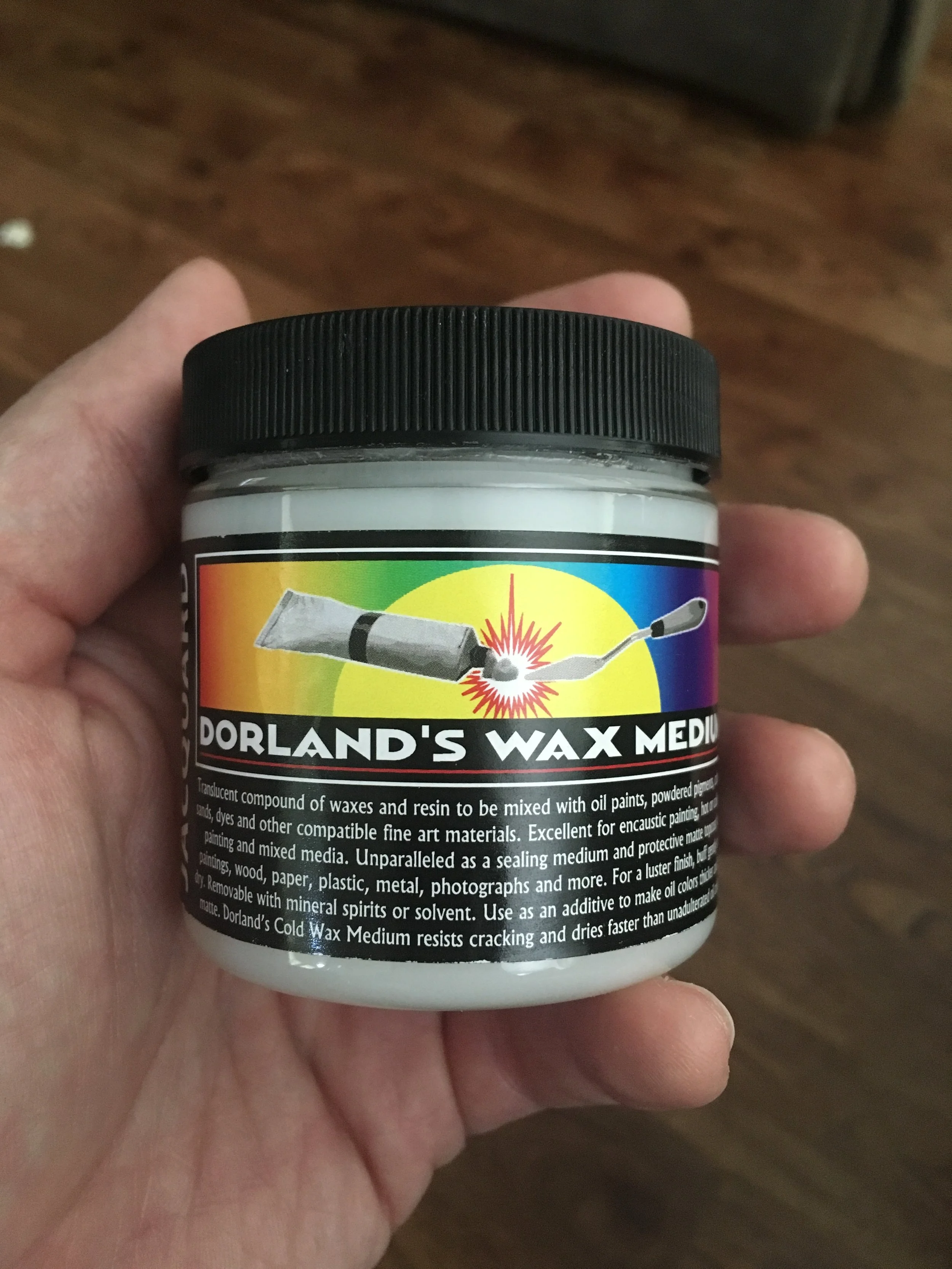
Now for the pièce de résistance: Dorland’s Wax Medium. This non-toxic, bees wax medium can be used as a finishing varnish directly onto a watercolor painting. That's right. It does not disturb the watercolor at all! It's clear, archival, and dries fast. Plus, it comes in a small 4 oz. jar (for about $8) which makes it easy for traveling, even on an airplane.
Since you are painting on prepared watercolor panels already, once your painting is signed and throughly dry, you can apply the wax right away. Use circular motions, like The Karate Kid, only much smaller circles. It dries quickly to a matte finish. It's not a high gloss, although you can add more and buff it for a luster finish, if desired.
Throw your new masterpiece into the frame and you're good to go. It's the easiest, fastest way to coat a watercolor painting that I know of. Give it a try and let me know what you think!
The Color of Water

This February, Kathryn and I flew to Charleston, SC, to be part of Robert Lange Studio's "The Color of Water" group show opening. The show celebrates the growing field of contemporary watercolor and features 20 artists from around the globe. I was delighted to learn that NOLA Beetle received the Editor's Pick from Art Mag.
The show is dedicated to the beauty and complexity of the watercolor medium, and Robert's toast opening night summed up the show nicely (below). I first visited Robert and Megan’s gallery in 2017 and you must stop by if you are ever in town; you will leave with a greater love for art. (Plus, not many galleries have an indoor swing or a grand piano that you’re encouraged to play.) I greatly appreciate that they are running a business voted Best Art Gallery in Charleston 2010-2017, while being incredibly talented artists themselves.
All are welcome here, and it’s an honor to have my paintings on the wall along side of Laurin McCracken, Dylan Scott Pierce, Alexandra Becker-Black, Joshua Flint, Kerry Brooks, Mario Robinson, Jason Drake, Nick, Runge, Endre Penovac, Kevin Taylor, Oriol Angrill Jorda, Katie Green, Adam Lister, Ester Sarto, Michiyo Fukushima, Karl Mårtens, Denny Bond, Melanie Norris, Reuben Negron.
The exhibition will hang through the months of January and February.
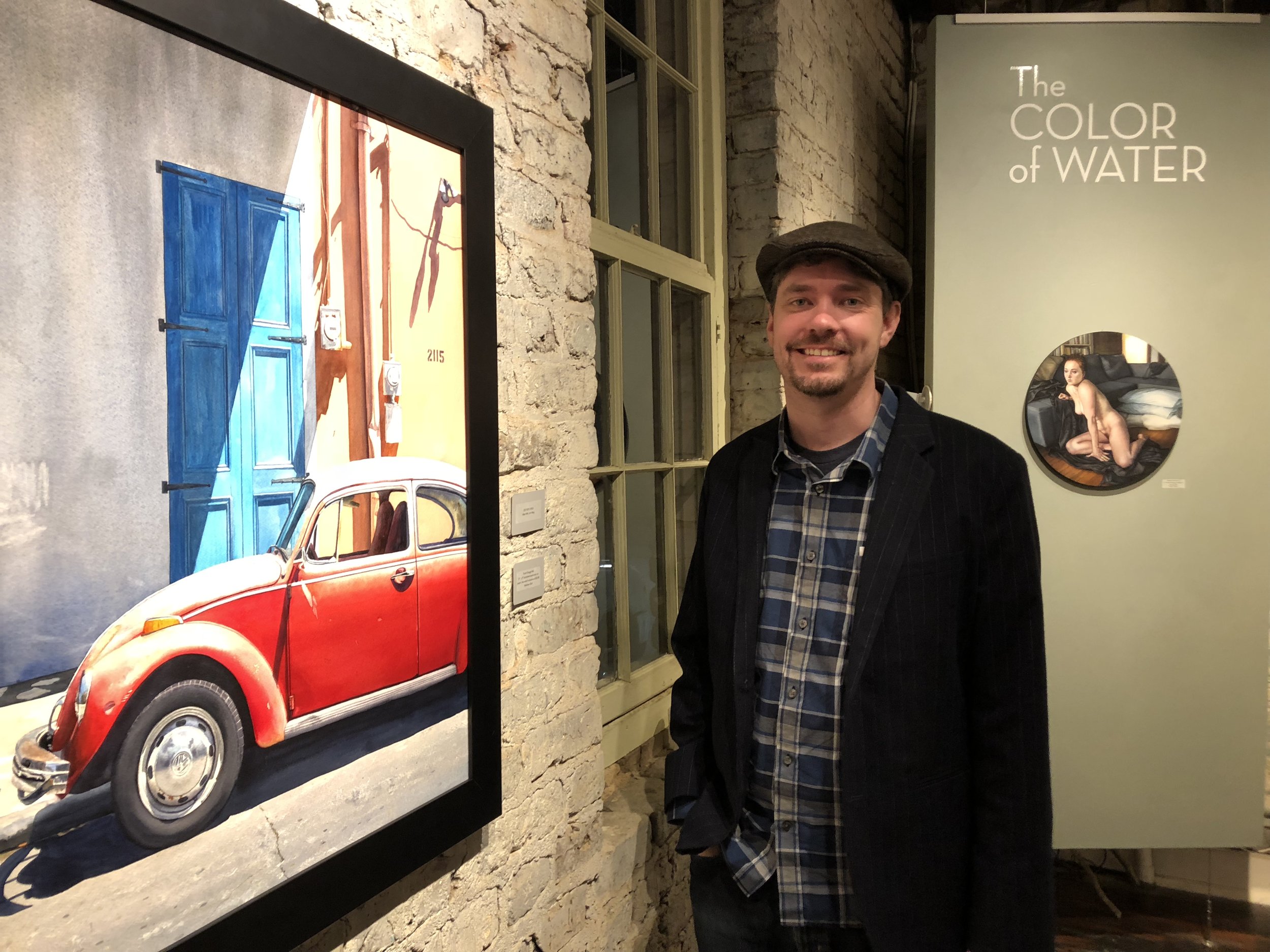


Photos from opening night, February 2, 2018.
Cats vs. Dogs

Group Show
Opens October 19, 2017 through May 2018
In collaboration with Robert Lange Studios, and benefiting the Charleston Animal Society, the Vendue Hotel is sponsoring a show titled “CATS vs DOGS” which will open October 19, 2017. Each invited artist has made one piece that is dominated by the theme Cat or Dog.
Viewers of the exhibit will be asked to vote and at the end of the exhibit, a winner will be announced answering the age old question — which is better Cats or Dogs? And the best part? A portion of the sales from the exhibit will be donated to the Charleston Animal Society.
I was invited to participate as a "dog" person. The story of my painting, "Looking Forward" is below.

Looking Forward
Varnished watercolor on paper, mounted on aluminum panel, 28.75 x 25 in
This is a painting of my neighbor Matt and his mutt. Matt is a great guy who has recently come out of a very rough time in his life. His wife got into drugs and alcohol, went to prison, rehab, divorced him and left him a single father of an eight-year-old girl. Through it all, his dog Nala was by his side.
Near our neighborhood there is an abandoned psychiatric hospital campus, built around 1900. Running throughout the hospital grounds with Nala became therapeutic for Matt, and it's where I decided to have him sit for the painting.
To me, Matt is taking one last look to the past with a new face of strength and determination, and Nala is helping him look to the future—reinforcing that Matt isn’t starting over, but moving forward.
Varnishing Watercolor Paintings

Varnishing Watercolor Paintings
Many (if not most) watercolor artists do not varnish their watercolor paintings. There are many good reasons for this, but there are also some advantages to the process. So I decided to roll up my sleeves and give it a try.
Traditionally, watercolors are put behind glass to preserve and protect them. "Museum" glass is really quite amazing in the way it protects agains UV rays and has little glare. But it's also REALLY expensive and I've been working on the larger side recently, which is even worse. Glass is very heavy, and it's difficult to ship without breakage. This is why many exhibitions require plexi glass be used for all shipped artwork.
But the glare on plexi glass bothers me. And the non-glare variety seems slightly hazy, certainly less than ideal. So the main reason I want to try varnishing is to show my larger pieces in a gallery without glass.
There are a lot of options on the market, and I've talked to other artists that do variations of the same basic idea. I decided to play it safe and do some tests on an older painting, so if I messed it up it wouldn't be a big deal. First, the finished watercolor paper needs to be mounted to a rigid surface. The most common is a wood panel or stretcher bars/canvas, but I chose an aluminum panel (see my blog post here for more on that).
I tried two different finishes. The first was a wax resign, typically used with oils, but perfectly fine for this use. (I used Dorlands Wax Medium.) It's my understanding that this non-yellowing resin has been used since Antiquity, and has been been found on the surfaces of ancient wall paintings. The amazing thing is it rubs on with a cloth without disturbing the watercolor at all. I was as skeptical as you probably are reading that, but it's true. After it dries it can be buffed for a luster finish, but it's definitely not a high gloss.
To achieve that, I used Golden Polymer Varnish. But in this case the watercolor definitely needs an isolation coat or fixative sprayed on before the varnish is applied. I sprayed on 8 thin coats of UV resist. This is best done outside or in a well ventilated area. Don't over do it! The last thing you want is a drip to form. Let each coat dry before applying the next.
Finally, mix 4 parts varnish with 1 part water and brushed it on with a 3" nylon brush. There was a slight haze at first, but it turns clear once it is dry. Also be careful not to go back and brush over areas too much, or it will cloud the finish.
This is a water based medium, so it cleans up easily. The down sides are you have to work quickly and it doesn't level out perfectly. I had slight brush strokes remain, which I thought was a nice look, but for a completely smooth finish I think I'll need to use a solvent based varnish. Stay tuned for that test...

At the right angle you can see the gloss finish.

"The word that you wanted was al-you-mi-ni-um"
"The word that you wanted was:
al-you-mi-ni-um"
2020 UPDATE: I’ve been working with Raymar on a product that eliminates all of the panel prep work. They offer Fabriano Artistico Cold Press ACM Watercolor panels and you can use coupon code BIRD20 for 20% off (note they are sold in packs of two).
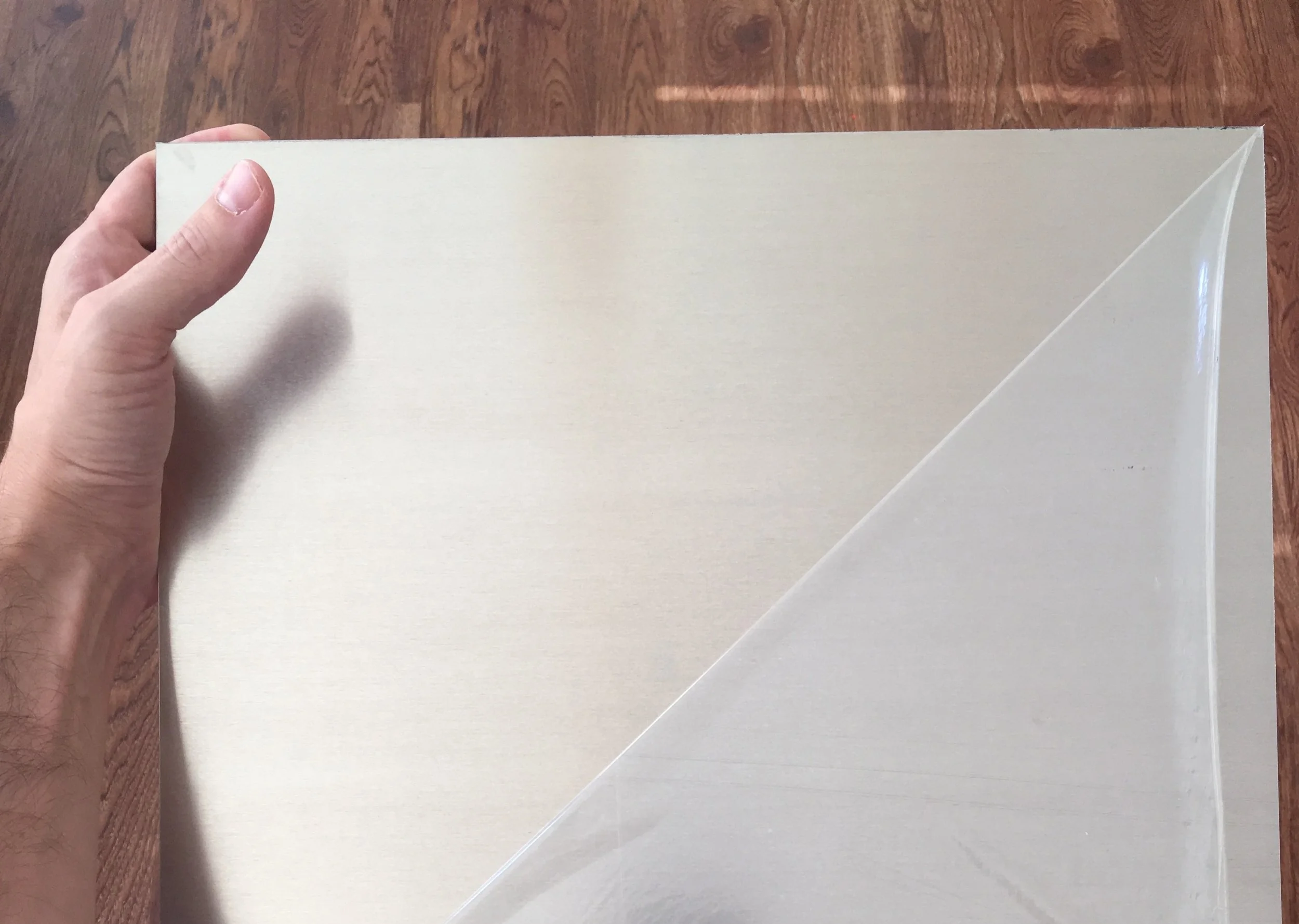
Aluminum panel has become a very popular surface to paint on in recent years. It's rigid, light weight (cheaper shipping!) and totally archival.
Although I'm now a watercolorist, I used to prefer wood panels when I painted with oils and acrylic because I liked the smooth surface for fine detail work. But over time, wood contracts and expands with changes in temperature and humidity. Stretched canvas is even worse. I've never seen it happen personally, but when I think about portraits potentially being passed down for generations, making sure my work is archival is important.
Every time I'm in a museum with a friend or family member, they ask some variation of this question: "Why do all the paintings have cracks in them?" Canvas swells and contracts at different rates than the layers of paint on top, which causes tension and stress. There are other reasons too, but that's a big one.
And it doesn't happen with aluminum. George O'Hanlon at Natural Pigments has done a lot of research and writing around the archival qualities of artists' materials and you can easily burn a few hours reading up on it.

So, when I decided to mounting some recent watercolor paintings, my first choice was to try aluminum. I have the metal cut to size, slightly smaller than my sheet of paper. Then I use a matte medium as an adhesive, spreading it on the aluminum and the back of the paper. These are sandwiched together, carefully avoiding bubbles or air pockets.
Then I stack a bunch of heavy books on top and let it dry overnight. When I come back it's perfectly flat and evenly supported. After trimming the paper from the edges, the painting is ready to be coated. Varnishing is not going to work if the painting buckles or bends, so mounting the paper to a good surface is an important first step.
I'll have more on the varnishing process soon! (here)
The Great White Mountains

I climbed some mountains.
The climbing part was not fun, but naturally the summits delivered some incredible views once the weather cleared. We were pretty high up (second tallest mountain on the east coast) and were looking down on bumps that were bigger than any "mountain" in my home state of Maryland.
During the assent, I was struck with how the plant life changed with the altitude. The colors and textures stood out the most. There were times I would see a color on a plant and remark to my friends how unique it was. I often see things and consider how I would paint them. Or how I would mix a certain color.
I did do some quick sketching, and took a few photos, but it was enjoyable to just take everything in for a change, without having to "capture" it. However, I did take some pics, and they speak better than my rambling.


Photos by Andrew Appler, Ron Appler, Matthew Bird